About Me
What Got Me Here?
Obligatory TW:
This post includes discussions of childhood instability, emotional and mental abuse, poverty, substance use, grief, loss of children, illness, and mental health conditions including ADHD, complex PTSD, and rejection sensitivity dysphoria.
These experiences are shared with care and intention, but some content may be activating. Please read at your own pace, take breaks when needed, and prioritize your safety and well-being.
I genuinely hope to support whomever may need it, using my lived experience a way to move forward.

I grew up poor in a house where fighting was part of the daily rhythm. It wasn’t occasional or situational — it was constant. Loud arguments, emotional volatility, and mental abuse shaped the atmosphere of our home. I learned early that peace was temporary and unpredictable, and that staying alert mattered more than feeling safe.
We moved almost every year. New houses, new towns, new schools. Just as I began to get my footing, we would leave again. There was no time to settle, no sense of continuity. I learned not to get too attached to places, people, or routines because everything felt temporary. Stability wasn’t something I experienced; it was something I watched other people have.
At home, emotions were weapons. Words cut deep and stayed lodged inside me long after they were spoken. I learned to read moods, anticipate reactions, and adjust myself accordingly. My nervous system adapted to chaos. I stayed hyper-aware, always scanning for the next emotional shift. I didn’t know it then, but this was survival.
By the time I was a teenager, I carried a constant, quiet question with me: What is wrong with me? I never felt like I fit in. Social situations felt confusing and exhausting. I watched other people seem comfortable in their own skin while I felt like I was always performing some version of myself, trying to get it right.
I assumed the problem was me. I internalized the instability around me and turned it inward. I believed I was defective in some way — too sensitive, too distracted, too much, or not enough. I didn’t have language for trauma, ADHD, or nervous system responses. I only had self-blame.
At fourteen, I found two things that would shape the rest of my life: drugs and alcohol, and a guitar.
I taught myself to play guitar by ear and instinct. Music gave me something solid to focus on. When I played, my thoughts quieted and my body settled. For the first time, intensity felt like expression instead of liability.
Alcohol and drugs offered something different. They numbed what I couldn’t explain. They slowed my mind and dulled the constant feeling that I was failing at being human. At first, they felt like relief. I didn’t see them as dangerous — I saw them as tools.
Loss would later force everything into focus.
In 2011, my seven-month-old child passed away from SIDS. Grief didn’t feel like an emotion — it felt like an environment I was suddenly living inside. I kept moving because stopping felt impossible.
In 2020, my eight-year-old child passed away tragically. Later that same year, my mother died during her second battle with cancer. Grief didn’t arrive one loss at a time — it stacked, relentless and overwhelming.
In June of 2021, I totaled our family car. I was alone, and thankfully no one else was involved, but the accident shook me deeply. In October of 2022, my oldest daughter ran away. For almost a week, we didn’t know where she was. She is safe now, but the fear of those days still lives in my body.
Later, a diagnosis of ADHD and complex PTSD finally gave language to a lifetime of confusion. Suddenly, my story made sense.
Through every version of my life — the chaos, the losses, the numbness, and the slow understanding — music stayed. I didn’t know it then, but it was something I was holding onto.
This is where my story begins — not with healing, and not with answers, but with survival before I knew what I was surviving.
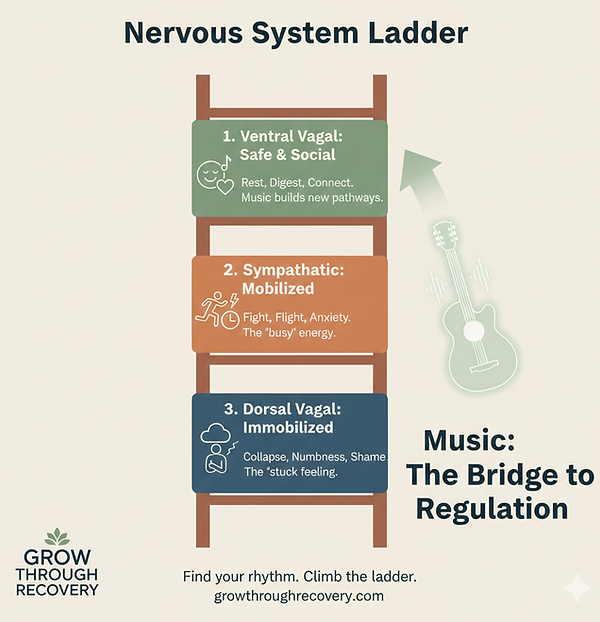
1. The Top Rung: Ventral Vagal (Safe & Social)
This is the "Green Zone." When you are here, your nervous system feels regulated and secure.
-
The Feeling: Calm, connected, curious, and creative. You are able to listen to music and actually hear the nuances.
-
The Function: This is the state where healing, digestion, and rational thinking happen. In this state, you can look at your recovery goals with clarity and hope.
-
Musical Connection: This is like a perfectly tuned instrument—clear, resonant, and ready to play.
2. The Middle Rung: Sympathetic (Fight or Flight)
This is the "Yellow/Red Zone." Your body has detected a threat (like a craving, a conflict, or a trauma trigger) and is preparing you to take action.
-
The Feeling: Anxiety, anger, restlessness, or a racing heart. You feel like you must move or escape. This is often where "survival mode" lives.
-
The Function: It mobilizes energy. It’s meant for short-term survival, but staying here too long leads to recovery burnout.
-
Musical Connection: This is like a high-tension, dissonant chord that hasn't resolved yet. It’s loud, fast, and frantic.
3. The Bottom Rung: Dorsal Vagal (Freeze or Shutdown)
This is the "Blue Zone." If the threat feels too big to fight or escape, your system "pulls the plug" to protect you from the pain.
-
The Feeling: Numbness, hopelessness, "brain fog," and exhaustion. You feel disconnected from yourself and the world.
-
The Function: It’s a conservation mode. Your body is trying to disappear or "play dead" to survive the overwhelming stress.
-
Musical Connection: This is like a muted string or a heavy, flat silence where the music has stopped entirely.
Survival mode wasn’t something I consciously chose. It was something my body and mind
slipped into early, long before I had language for it. When your environment doesn’t feel safe,
your nervous system adapts.
For me, survival mode meant staying busy, staying distracted, and staying one step ahead of
my own emotions. Silence was dangerous. Stillness invited thoughts and memories I didn’t know
how to handle. Isolation became one of my primary strategies. Being alone felt safer than being
misunderstood or rejected. Over time, isolation stopped being a choice and became a default.
At the same time, I learned to people-please. I read rooms quickly, adjusted myself, and kept
the peace. I became agreeable and reliable, praised traits that hid the cost underneath. I
overrode my own needs to avoid conflict. Masking tied it all together. I learned how to appear
calm, capable, and functional even when I felt disconnected inside. The mask worked, but it
required constant effort and left me unseen.
Alcohol fit seamlessly into this system. At first, it felt like relief. Over time, the line between
coping and dependence blurred. Survival mode rewards functionality, not health.
From the outside, my life looked resilient. From the inside, it felt like endurance. I wasn’t living,
I was bracing.
Survival mode doesn’t end suddenly. It erodes. Rejection sensitivity dysphoria became impossible to ignore. Small interactions triggered overwhelming shame. My nervous system treated perceived rejection as danger.
Cognitive distortions took over. I mind-read, catastrophized, and assumed failure. Thoughts felt absolute and true.
Alcohol numbed the intensity — until it amplified it. Trauma, distorted thinking, and alcohol fed each other in a tightening loop.
Eventually, I realized I could no longer trust my coping strategies to keep me safe.
The breaking point wasn’t dramatic.
It was clarity.
Something had to change.
Change didn’t start with feeling better. It started with honesty.
ADHD and complex PTSD reframed my life. Accountability shifted from shame to awareness.
Unmasking meant small acts of honesty. Saying no. Asking for clarity. Letting myself be seen.
Growth wasn’t linear. It was intentional.
I wasn’t chasing a version of myself without trauma.
I was learning to live honestly with the one I had.
Healing came through tools, not breakthroughs.
Music became regulation instead of escape.
Structure became safety.
Mindfulness interrupted old loops.
Alcohol urges became signals, not commands.
Accountability replaced motivation.
Reflection turned setbacks into information.
Healing became a daily practice.

Questions or comments?