Recovery and Identity: Who Am I Without the Mask?
- Feb 3
- 4 min read
It wasn’t something I consciously put on each morning. It developed slowly, as a way to move through the world with less friction. Less explanation. Less attention. Less risk.
The mask did its job. Until it didn’t...

When Identity Is Built Around Survival
Masking often begins as a survival skill.
You learn how to read rooms. You learn which parts of yourself to soften or hide. You learn how to appear capable, steady, unaffected, even when you’re not.
Over time, those adjustments stop feeling like choices. They become habits. Eventually, they start to feel like identity.
And when recovery begins, when substances, distractions, or constant motion are removed, a quiet question often surfaces:
Who am I without the mask?
Why the Question Feels Unsettling
The question “Who am I without the mask?” can feel deeply uncomfortable because the mask wasn’t just hiding pain, t was organizing life.
For a long time, it provided structure. It gave you a way to move through the world that felt predictable, even if it was exhausting.
The mask shaped:
How you interacted with people
How you measured success and worth
How you stayed safe in uncertain situations
How you avoided overwhelm or emotional exposure
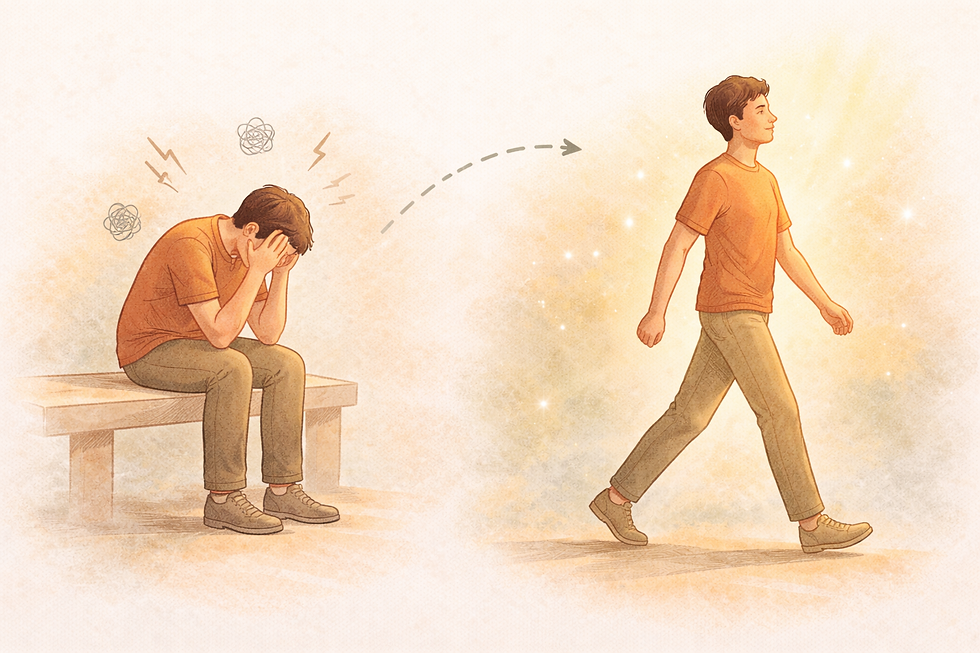
When those patterns are removed, it can feel like the floor drops out from under you. Even if the mask was heavy, it offered orientation. It told you what to do, how to respond, and what to prioritize.
Letting go of it can feel like losing structure, not because you’re incapable, but because the system you relied on is no longer running.
In recovery, that loss doesn’t mean you’re failing. It usually means something important is shifting. The strategies that once kept you going are being asked to evolve, not because they were wrong, but because they’re no longer necessary in the same way.
That moment of unsettlement is often a sign of growth. It marks the point where survival patterns begin to loosen, making room for something more sustainable to take their place.
Identity Doesn’t Reappear All at Once
One of the most common misconceptions about recovery is that once you stop coping the old way, your “real self” shows up fully formed.
That’s rarely how it works.
In reality, letting go of old coping strategies often creates a pause — a space where the structure you relied on is gone, but nothing has fully taken its place yet. That gap can feel unsettling. For a long time, your identity may have been shaped by survival, adaptation, and keeping things moving. When that effort stops, it can feel like there’s less to hold onto.
Identity in recovery doesn’t arrive as a revelation. It begins to form quietly, through everyday experiences and small moments of awareness.
You start to notice:
What actually feels calming rather than distracting
What drains energy instead of sustaining it
What you’re drawn to without needing a reason
What you no longer want to maintain out of habit or expectation
These observations don’t announce themselves. They tend to show up when you’re paying attention — in moments of rest, routine, or reflection.
Over time, those small signals begin to matter. They guide choices, shape boundaries, and slowly replace the identity built around coping. Not all at once, and not in a straight line — but steadily.
Recovery doesn’t hand you a finished version of who you are. It gives you the space to notice, respond, and adjust. Identity becomes something you discover through living, rather than something you decide in advance.
And while that process can feel uncertain at times, it’s also more flexible and honest than anything built solely around survival.
Music as a Low-Pressure Place to Explore Identity
One of the reasons music has remained such a steady part of my own recovery is that it doesn’t demand a finished identity.
You don’t have to explain who you are. You don’t have to perform confidence. You don’t have to know where you’re headed.
You just interact with sound, rhythm, and repetition.
Some days that reveals frustration, some days it reveals calm, some days it reveals nothing at all.
All of that counts.
Music becomes a place where identity can surface without being forced, where you can notice how you respond instead of how you’re perceived.
Unmasking Isn’t About Becoming Someone New
Unmasking isn’t about replacing one identity with another.
It’s about reducing effort.
It looks like:
Saying no without explanation
Letting interests change
Allowing rest without guilt
Choosing familiarity over approval
Over time, the question shifts from “Who should I be?” to “What feels sustainable?”
That’s not a loss of identity. It’s the beginning of a more honest one.
Letting Identity Be In Progress
Recovery doesn’t require a clear answer to who you are.
It requires space, space to try things, space to change your mind, and space to notice what supports you and what doesn’t. It requires a willingness to accept the challenges and move forward. Identity doesn’t need to be defined to be real. Sometimes it just needs room to unfold, without performance, without pressure, and without the mask doing all the work.
This post builds on recent conversations about masking, burnout, and recovery — and the quieter work of learning who you are when survival is no longer the main focus.
Music can be a quiet place to explore who you are without needing to perform.
If you’re curious about using music as a grounding, non-judgmental practice, you can learn more about working with me below.


Comments