How Music Promotes Neuroplasticity in Addiction Recovery
- Jan 16
- 4 min read
Updated: Jan 19
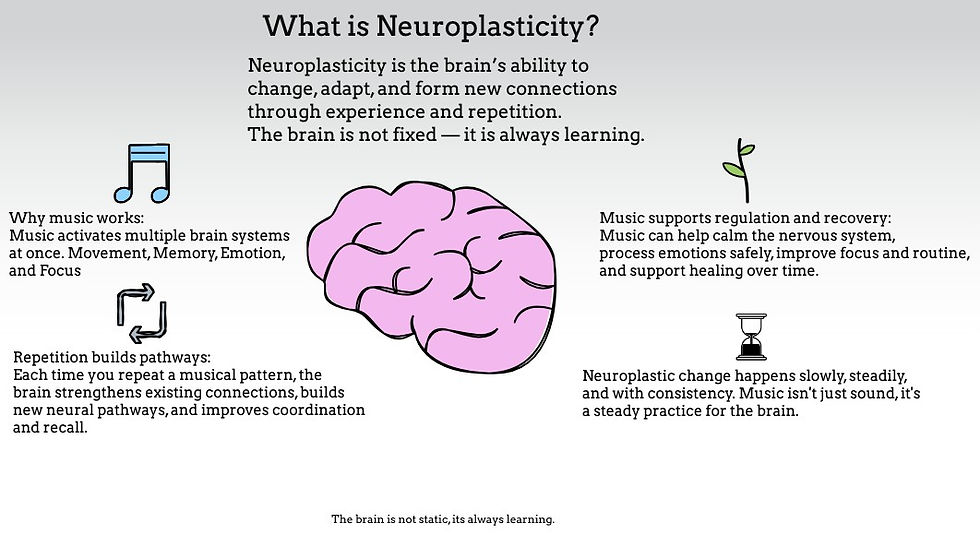
The brain is designed to change. Not quickly, not dramatically, but steadily through repetition, attention, and use.
This ability is often called neuroplasticity: the brain’s capacity to form new connections and strengthen existing ones over time. It’s not a trick or a shortcut. It’s a process.
And music happens to work with it very well.
Repetition With Attention Changes the Brain
The brain builds new pathways through repeated actions that require focus.
Music checks both boxes.
When you practice music, even simply, you’re asking the brain to coordinate:
Movement
Timing
Listening
Memory
Attention
Each time you repeat a scale, a rhythm, or a familiar progression, you’re reinforcing communication between different parts of the brain. Over time, those connections become more efficient.
That’s why things that once felt awkward start to feel natural.
**Try This: The 5-Minute "Neural Anchor" Exercise**
You don’t need to be a professional musician to start building new pathways. You just need repetition with attention. Try this 5-minute practice today to begin rewiring your response to stress:
Pick One Note or Chord: If you have an instrument, pick one sound that feels "grounding" to you. If you don't, use your voice to hum a single, steady low note.
The 4-Count Breath: Strike the note or hum as you breathe in for 4 seconds, then let the sound ring out as you breathe out for 4 seconds.
Narrow Your Focus: As you repeat this, close your eyes. Focus entirely on the physical vibration—feel it in your fingertips or your chest. If your mind wanders to a craving or a worry, gently bring it back to the sound.
Repeat 10 Times: This simple loop of Sound + Breath + Focused Attention is a workout for your brain. You are literally telling your nervous system: "In this moment, we are safe, and we are in control."
Why Music Is Especially Effective
Music isn’t passive. You don’t just think about it you do it.
Playing an instrument engages:
Motor skills (hands, posture, coordination)
Sensory input (hearing, touch)
Cognitive processing (pattern recognition, anticipation)
Emotional regulation (tension, release, focus)
Few activities involve that many systems at once in such a structured way. That combination is what makes music a powerful tool for building and reinforcing neural pathways.
Small Practice Still Counts
One of the most important things to understand about neuroplasticity is that it responds to consistency, not intensity. You don’t need long or demanding sessions to support change. Short, repeatable practice still signals the brain to strengthen connections. This is especially important on low-energy days.
Five minutes of familiar material still reinforces pathways. Returning matters more than pushing.
Learning Music Creates New Options
As you continue learning, the brain doesn’t just store information — it becomes more adaptable.
New musical vocabulary creates:
Faster pattern recognition
Better coordination
More flexible responses
That flexibility carries over into other areas of life. The brain gets better at adjusting instead of defaulting to old patterns.
This is one reason music can feel grounding and stabilizing over time.
Why This Matters in Sobriety
In sobriety, the brain is often relearning how to regulate itself without substances.
Music provides:
Structure without pressure
Engagement without overwhelm
A constructive focus during restless moments
A predictable practice that supports regulation
Each time you return to your instrument, you’re reinforcing new, healthier pathways — not through force, but through use.
It’s not about replacing one habit with another. It’s about giving the brain something steady to build around.
Simple and Complex Practice Both Help
Simple practice reinforces existing pathways.Complex practice challenges the brain to build new ones. Both matter.
Simple days maintain connection. Complex days expand capability.
Over time, that balance supports real, lasting change both musically and neurologically.
Change Happens Quietly
Neuroplasticity doesn’t feel dramatic while it’s happening.
It shows up later as:
Less hesitation
Better focus
More ease
Greater confidence
Music doesn’t force the brain to change, it gives it a reason to and over time, that reason adds up.
Rewire Your Recovery Journey
Understanding how your brain changes is the first step; consistent practice is what makes it stick. If you're ready to move beyond "just getting through the day" and want to start proactively building a resilient, regulated nervous system, I’m here to guide you.
Work With Me 1:1: Let’s design a musical practice specifically for your recovery goals. View Guided Support Options
Deepen Your Practice: Download my Digital Resources for more exercises designed to bridge the gap between music and healing.
You aren't just playing music; you’re rebuilding your brain. Let's get started.
If you enjoyed this, check out my latest post on Regulating the Chaos to see how we use music to stay on track
📌 Sources & Further Reading
The ideas shared in this post are supported by well-established research on learning, repetition, and how the brain adapts through consistent use. If you’d like to explore further, these sources offer clear, accessible overviews:
Harvard Health Publishing – Why music is good for the brain
Harvard Medical School Magazine – How music resonates in the brain
National Institutes of Health (PMC) – Music training and neural plasticity
The Dana Foundation – Music, learning, and brain research
Scientific American – Music, cognition, and neuroplasticity (general audience articles)
These sources reflect a broad scientific consensus: the brain strengthens and builds connections through repetition, attention, and consistent engagement.


Comments