Consistency Over Intensity: How to Avoid Recovery Burnout
- Dec 26, 2025
- 3 min read
Updated: Jan 17
Building Consistency in Recovery (Without Burning Yourself Out)
One of the hardest parts of recovery isn’t stopping — it’s staying consistent afterward.
Not consistent in a perfect, high-energy way.Consistent in a real-life way.
Many people in recovery struggle with:
Starting strong and then fading out
Feeling overwhelmed by routines
All-or-nothing thinking
Shame when they miss a day
If that sounds familiar, you’re not alone — and you’re not doing recovery wrong.
Why Consistency Is So Difficult in Recovery
Substances often provided structure, relief, or regulation — even when they caused harm. When they’re removed, the nervous system can feel unsteady, scattered, or exhausted.
That makes consistency harder, not easier.
What helps most isn’t more discipline. It’s gentle structure — something predictable, supportive, and flexible enough to meet you on hard days.
Music as a Steady Practice
Music works well in recovery because it doesn’t demand a certain mood or mindset.
You don’t have to feel motivated.You don’t have to feel calm.You don’t have to feel creative.
You just show up.
Simple music practices give your nervous system:
Rhythm instead of chaos
Focus instead of rumination
Repetition instead of pressure
Even a few minutes can create a sense of stability — and over time, that stability builds trust with yourself.
Small Practice Counts
One of the biggest misconceptions about learning music is that it has to be time-consuming or intense to be effective.
In reality:
Five minutes counts
Playing the same chord counts
Repeating one pattern counts
Consistency isn’t about doing more. It’s about doing what’s sustainable.
In recovery, sustainable always wins.
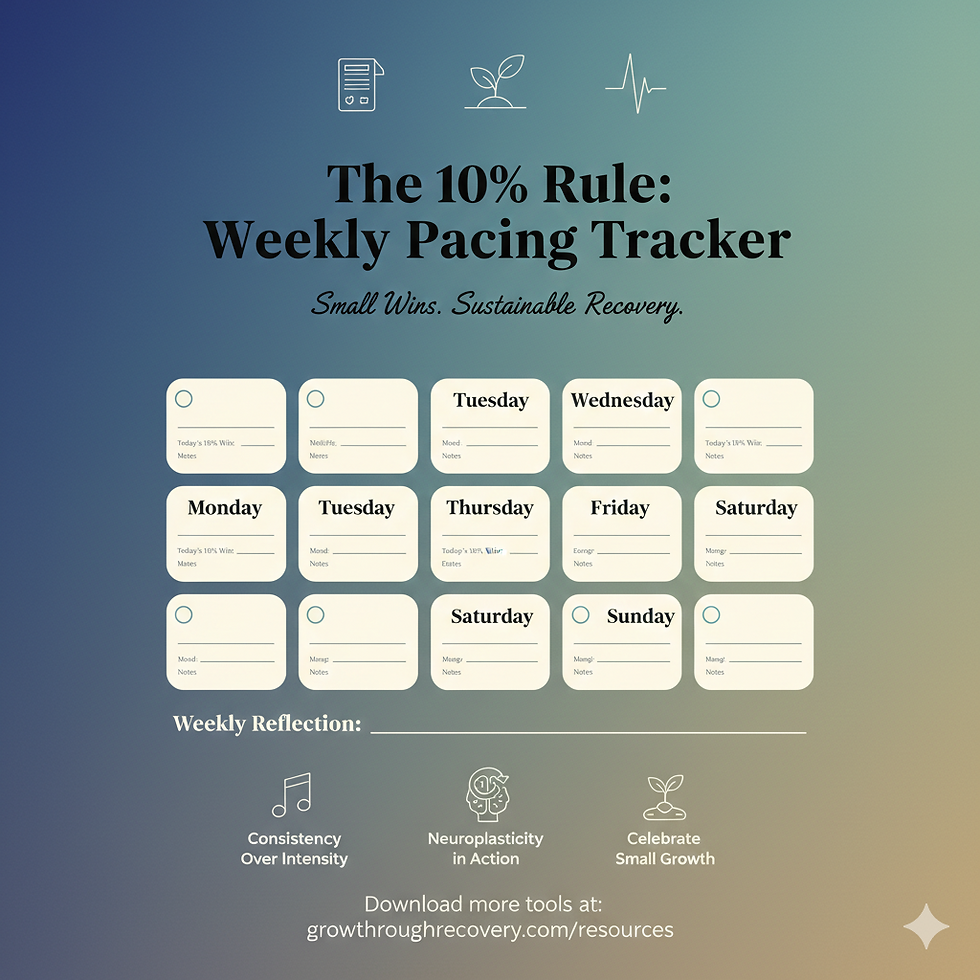
**The 10% Rule: Breaking the All-or-Nothing Cycle**
Most of us fall into the trap of "intensity over consistency." We decide we’re going to practice guitar for an hour every day, attend every meeting, and journal for twenty minutes. When life gets heavy and we can't do all of it, we often do none of it. This is how recovery burnout starts.
The 10% Rule is your permission slip to be imperfect. It’s based on a simple idea: Doing 10% of your practice is infinitely better than doing 0%.
If you can’t practice for 30 minutes: Can you sit with your instrument for 3?
If you can’t listen to a full recovery podcast: Can you listen to one 60-second clip?
If you can’t do a deep dive into your nervous system: Can you take three "musical breaths" while humming a single note?
In music, a "rest" is just as vital as a note. If you try to play at 100% volume and speed all the time, you’ll eventually snap a string. By embracing the 10% Rule, you aren't "slacking"—you are pacing yourself for the long term. You are telling your brain that showing up matters more than "performing" perfectly.
Why Support Helps With Follow-Through
Many people try to build routines alone — and then feel discouraged when it doesn’t stick.
Support changes that.
Having someone to:
Help you set realistic goals
Normalize missed days
Adjust the practice when life gets heavy
Offer accountability without shame
can make the difference between giving up and staying connected.
This is where one-on-one music sessions can be especially helpful — not as pressure, but as support.
How 1:1 Music Sessions Fit In
One-on-one sessions are designed to help you:
Build a consistent, manageable practice
Use music for grounding and regulation
Learn at your own pace
Stay connected when motivation dips
Sessions are recovery-informed, but they are not therapy or crisis support. They’re meant to complement the recovery tools and supports you already have.
A Steady Path Forward
Recovery doesn’t require constant effort — it requires steady care.
Music can be one of the few places where progress feels possible without pressure, where showing up imperfectly still counts, and where consistency feels supportive instead of overwhelming.
If you’re looking for a grounded, realistic way to support your recovery through music, you’re in the right place.
When you’re ready, one-on-one sessions are available. Until then, take your time — and keep going.
Recovery is a marathon, not a sprint. > If you're feeling overwhelmed and need help finding a pace that actually works for your life, let's talk. No high-pressure systems—just a sustainable, musical approach to staying on track.


Comments