Why Learning Music is Like Learning a New Language for Recovery
- Jan 2
- 3 min read
Updated: Jan 17
Music is as much honing a skill as it is learning another language.
At first, you know what you want to say, but you don’t have the words. Your hands don’t quite respond the way you expect. Your timing is off. You repeat simple phrases because that’s all you have access to. That’s not failure, that’s fluency developing and it takes time and consistency to develop.
A Small Vocabulary Still Communicates
Early on, musical vocabulary is limited. A few chords. A scale shape. A rhythm that mostly works. However, limited vocabulary doesn’t mean limited expression. In fact, it often leads to clearer expression. Fewer options force you to pay attention to tone, space, and timing — the musical equivalent of speaking slowly and choosing words carefully.
Simple playing isn’t empty. It’s direct.
**Your First 3 "Words" in the Language of Music**
If you feel like you don't have the words to describe your current state, try "speaking" with these three musical concepts instead:
1. The "Open Note" (The Word for: Awareness)
An open note is a string played without pressing any frets. It is the purest, simplest sound the instrument can make.
The Practice: Pluck a single open string and just listen to the sustain until it disappears.
The Meaning: This is the vocabulary for "I am here." It’s a way to check in with your environment and your body without any pressure to "perform" or change anything.
2. The "Dissonant Chord" (The Word for: Tension)
Dissonance happens when two notes "clash," creating a sound that feels unfinished or uncomfortable.
The Practice: Intentionally play two notes right next to each other that sound "wrong" or tense. Hold that tension for a moment.
The Meaning: This is the vocabulary for "I am uncomfortable." By playing the tension, you externalize it. You realize that the tension is something you are making, not something that is you.
3. The "Resolution" (The Word for: Release)
Resolution is the act of moving from a tense, dissonant sound to a harmonious, "home" chord.
The Practice: Play that "clashing" dissonant chord again, then immediately move your fingers to a clear, bright G major or C major chord.
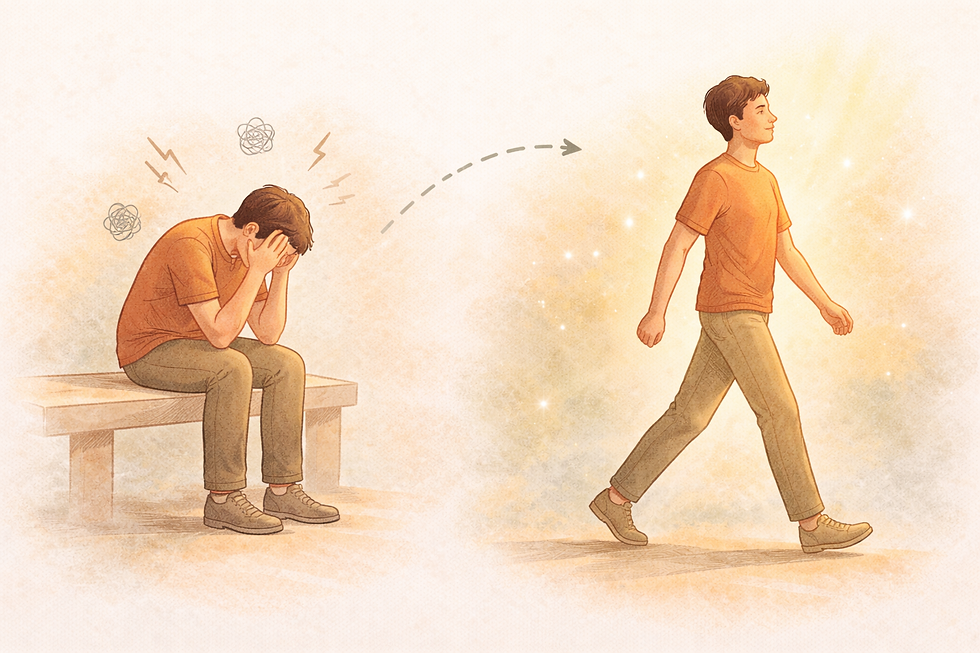
The Meaning: This is the vocabulary for "I am letting go." It teaches your nervous system that tension is temporary and that you have the power to move toward a state of rest.
Why This Matters for Your Recovery
Just like learning a spoken language, you will "stutter" at first. Your fingers might buzz, or your timing might be off. In the language of music—just like in the language of sobriety—fluency comes from staying in the conversation. Music Says What Words Sometimes can't.
One reason music has mattered so much to me is that it gave me a way to express things I couldn’t easily put into words and sometimes didn’t want to.
There are internal states that don’t need explaining: tension, relief, restlessness, focus, calm.
Music doesn’t ask you to define any of that. It just lets you shape it.
You don’t need the right sentence. You need the right sound.
Vocabulary Creates Choice
As you keep learning, your musical language expands.
New scales.
New rhythmic ideas.
New ways harmony can move.
Suddenly you’re not just repeating phrases — you’re choosing them.
That’s what vocabulary really gives you: options.
Different ways to say the same thing. Different responses to the same feeling.
More vocabulary doesn’t make the music louder or flashier. It makes it more precise.
Fluency Is Ongoing
There’s no point where learning music is “done.”
Even after years of playing, new ideas continue to shift how familiar things feel. A small rhythmic change can reframe an old progression. A new scale can open space you didn’t notice before.
Music stays useful because it keeps evolving — and so do you.
Why I Keep Learning
I continue learning music for the same reason I started: it gives me a way to communicate honestly without forcing clarity where there isn’t any.
Some days the language is simple.
Some days it’s more detailed.
Either way, it gives me somewhere to put things that don’t belong in words,and the more I learn, the more clearly I can say what I mean.
Quietly.
Directly.
Without explanation.
Ready to expand your vocabulary?
Learning a new language is always easier with a guide. If you’re tired of feeling "stuck" or "speechless" in your recovery, let's work together to find the sounds that help you heal.
1:1 Guided Support: Let's find your unique musical voice. Book a Session
Browse Resources: Get more tools for your recovery toolkit. View Digital Resources


Comments